Rugby union has four ways to put points on the board, and the differences between them explain plenty about how a match is played and won. Here is what each score is worth under World Rugby's laws, and how they add up on a real scoreboard.
How points are scored
- Try – 5 points, awarded when an attacking player grounds the ball, in control, in the opponents' in-goal area.
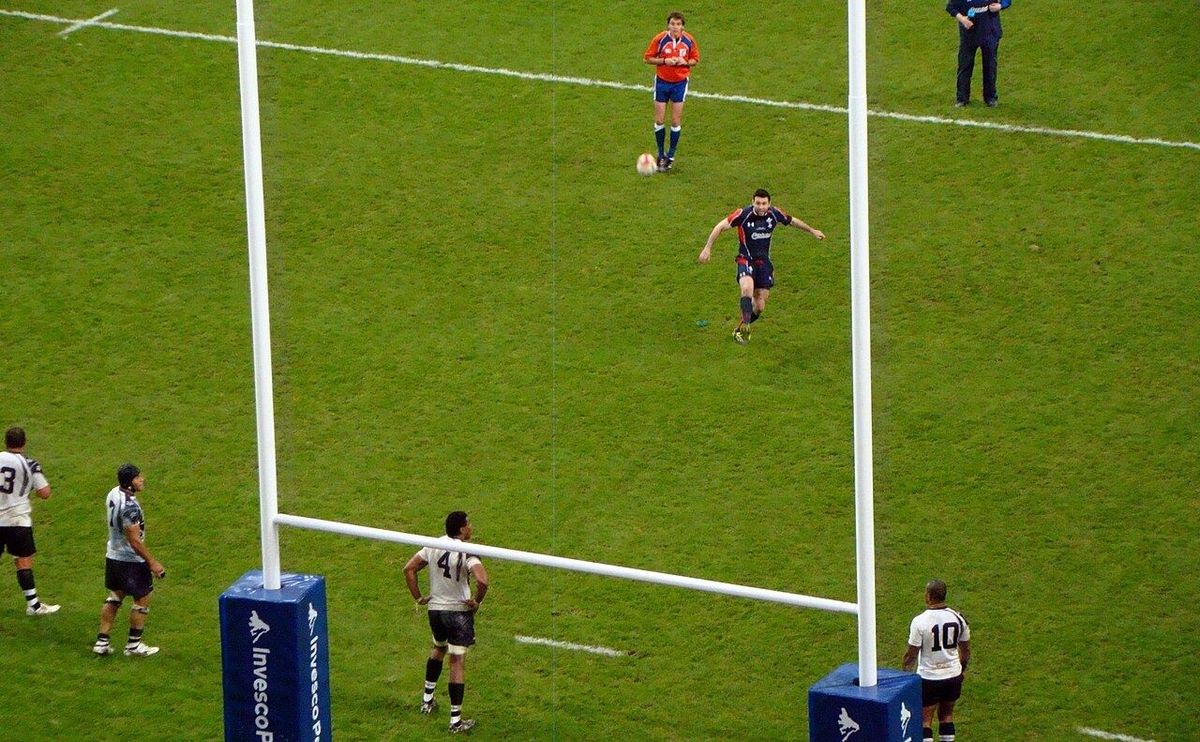
- Conversion – 2 points, a kick at goal taken after a try, from a point in line with where the try was scored.
- Penalty goal – 3 points, a kick at goal awarded for an offence by the opposing team.
- Drop goal – 3 points, scored by drop-kicking the ball over the crossbar and between the posts during open play.
- Penalty try – 7 points, awarded when foul play prevents a probable try; no conversion is attempted.
A conversion can be taken as a place-kick or a drop-kick, though almost every team place-kicks in the modern game. The kicker must send the ball over the crossbar and between the posts; missing means the try still counts, but the extra two points are lost. A penalty goal and a drop goal are both worth three points, but a penalty is awarded for an opposition infringement, while a drop goal can be attempted by either team in open play at any time, without a stoppage.
How a scoreline is built
A simple example shows how these add up: two converted tries and a penalty goal give a team 7 + 7 + 3, for 17 points. A team that scores three tries but converts only one, and adds a drop goal, would total 5 + 5 + 7 + 3, for 20 points. Because a converted try is worth more than two penalty goals, sides that finish attacks in the try zone typically outscore sides relying on penalties alone, though a strong goal-kicker can keep a team competitive without scoring many tries.
Rugby league scores differently
Rugby league, a related but separate sport with its own laws and governing bodies, scores differently: a try is worth 4 points, a conversion 2, a penalty goal 2, and a drop goal (called a field goal) just 1. The lower value placed on kicking, relative to union, is one reason league is generally seen as a more ball-in-hand game.
For a newcomer following a match, the two numbers worth remembering are five and three: tries are the biggest single score, and both penalties and drop goals are worth three, so a side can climb back into a game through accurate goal-kicking alone. Scoring values can occasionally change under law trials, so check World Rugby's official laws for the current rules.